Full-Range
Full‑Range Loudspeakers in Sound Reinforcement Systems
What it is
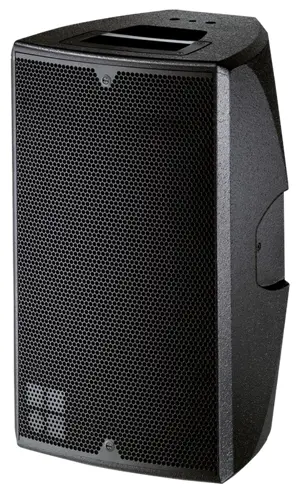
A Full‑Range Loudspeaker is a single cabinet in which one or more individual drivers cover the whole audio‑frequency range (or, at least, most of it).
In other words, a full‑range loudspeaker is a box with one or more individual drivers in it. The drivers may cover different frequency ranges (separated by one or more passive crossovers) or may all cover the same frequency range (the Bose 802 is an example of this).
Some full-range cabinets include amplification inside the cabinet, while others allow for separate (internal or external) amplification of individual drivers. As a potential source of confusion, both of these variations are commonly referred to as ‘active’ loudspeakers. ‘Powered’ and ‘bi-amplified’ (or ‘tri-amplified’) are less ambiguous terms, but if you intend to buy loudspeakers that are described as ‘active’ you need to be clear about what you are getting.
What it does
It converts variations in voltage (from an amplifier's output) into variations in sound pressure (through cone/diaphragm movement).
How it works
Generally, each individual driver covering any frequency range below about 3kHz works in the same way: the driver consists of a cone or diaphragm, attached to a coil which is suspended in a fixed magnetic field. Alternating current driven by the voltage from an amplifier's output runs through the coil, creating an electromagnetic field in the coil. The reaction between this and the fixed magnetic field causes the coil - and the attached cone or diaphragm - to move forwards or backwards. The amount and direction of current through the coil affect the amount and direction of coil (and cone or diaphragm) movement. The cone or diaphragm compresses the air in front of it as it moves forwards, and rarefies the air in front of it as it moves backwards. The variations in air pressure are recognisable as sound.
Very high frequency drivers in some budget loudspeakers use piezoelectric transducers instead of coils and magnets. Here, the amplifier's voltage is delivered to a piezoelectric element, which bends inwards or outwards when voltage is applied to it. The amount and polarity of the voltage directly affects the amount and direction of bending. The element compresses the air in front of it as it bends outwards, and rarefies the air in front of it as it bends inwards. The variations in air pressure are recognisable as sound.
Piezo drivers cannot usually reproduce frequencies below about 3kHz (and have very high impedance at lower frequencies), so are often used without crossovers in low-cost cabinets.
Drivers are generally mounted in full‑range cabinets in one of two ways:
Front‑loaded. The driver is mounted on the cabinet's front baffle. This means the cabinet can be relatively compact, and relatively inexpensive to manufacture. These advantages are obtained at the expense of efficiency and pattern control: horn‑loaded drivers are more efficiently coupled to the air they have to move, and a simple cone is less able to control the way sound radiates from it at all frequencies in its range. Most front‑loaded full‑range speakers have one or more holes (ports) in the front baffle, to maintain output at the lower end of the speaker's frequency range. The size and number of the holes (and length of any tubes, if the holes have tubes in them) take account of the internal dimensions of the cabinet and the driver's low frequency resonance. Do not replace drivers in a ported enclosure with anything other than the original type of driver. Also, do not make holes in sealed (unported) enclosures: the drivers are not designed for it, and at high power you are more likely to destroy the driver than to improve low frequency output.
Horn‑loaded. The driver is mounted at the back of a horn. This increases the cabinet's size, weight, and manufacturing cost. These disadvantages are offset by achieving greater efficiency and better pattern control: the driver can be more precisely coupled with the air in front of it, yielding a substantial improvement in output (6dB is not uncommon). Also, the horn controls the way the sound radiates, and very even frequency dispersion over more closely determined horizontal and vertical axes can be achieved.
Most budget to mid‑priced speakers use front‑loaded bass and midrange drivers. Almost all high‑frequency drivers are horn‑loaded. In practice, the use of horns in this way means that frequencies from around 1kHz upwards (depending on the horn, the driver and the crossover point) usually have reasonable pattern control. As this upper range includes the frequencies that are important for intelligibility, using a front‑loaded driver for lower frequencies is less of a disadvantage.
How do you use it?
Many loudspeakers don't have much of a manual, although many higher-end systems are intended for use with same-brand amplifiers and controllers, and setting up systems using equipment from a single manufacturer is generally fairly straightforward. Some manufacturers also provide more detailed information (including crossover points, amplifier gain, limiter and EQ settings), enabling their loudspeakers to be used with third-party equipment. If instructions are provided, always follow them carefully.
If all you are given is a speaker's nominal power handling and dispersion, apply as many of the following as you can:
- Use an amplifier rated between 1.5 and 2 times the loudspeaker's continuous power rating;
- Use a limiter. You will need to know the amplifier's gain to set limit points, but RMS limiting - if available - should be set to prevent average levels exceeding the loudspeaker's continuous capacity, and peak (or "brick-wall") limiting - if available - should be set to prevent instantaneous peaks from exceeding loudspeaker capacity or allowing amplifiers to clip. Many amplifiers include limiters that will at least prevent audible clipping;
- Use a high-pass filter. 50-60Hz, 24dB/octave is a good starting point for a single "full-range" cabinet, but you could raise this to 80-100Hz if you are only using it for guitar and vocals. Many amplifiers include a switchable high-pass filter;
- Use a low-pass filter. 16-18kHz, 24dB/octave is unlikely to have much audible effect, and will prevent inaudible high-frequency harmonics or oscillation from overheating HF drivers.
See the Speaker Position section for slightly more detailed guidelines about where to put them. The main things to bear in mind are:
- Point the speakers at the audience. If you think of it as a floodlight that dispenses sound rather than light (keeping its dispersion angles in mind) it will give you some idea of what to do. Point it at the audience, not at the side walls, floor or ceiling. In most small to medium‑sized live productions you will have one loudspeaker either side of the stage (or performance area, if there isn't a stage). Generally you will improve the sound in a number of ways if you angle the speakers inwards slightly (as a guideline, try aiming them so that imaginary lines from their centres cross about three‑quarters of the way to the back of the audience area). This will give better cover to the front part of the audience, and reduce the level of reflection from the side walls. As a development of this, it will also help if you raise the speakers and angle them downwards. If the speakers are quite high up (preferably at least 3 metres) and angled downwards towards the back of the audience, the higher frequencies will appear more similar in volume throughout the audience area. If the speakers are at head‑height, what sounds clear at the back may sound harsh at the front.
- Do not point the speakers at microphones. Keep speakers forward of any microphone positions, especially when angling them inwards (see above).
Do you need one?
For productions that need amplification, loudspeakers are obviously a requirement, and if you are equipping a venue or planning to take a touring programme to places that do not have suitable in‑house systems then you will need loudspeakers.
What sort do you need?
In selecting speakers, you should consider what sort of production they will be used for, how loud you need them to be (NOT - see Power, below - how much power they can handle!), and what sort of room they will usually be used in.
For small-capacity spaces (for audiences up to a hundred-or-so) a single pair of full‑range loudspeakers will cope with quite a wide variety of uses. For larger spaces, a multi‑enclosure loudspeaker system may well be more suitable, but many full‑range cabinets are designed so that they can also be used with separate bass units, and loudspeakers that can used in either configuration will allow some flexibility in both application and venue capacity.
If they will always be used in the same room, consider getting speakers with a wide area of horizontal cover (90° or more) if the room is short and wide, or with a narrower angle (60° or so) if it is long and narrow. For most other rooms, and for general‑purpose use, 70° to 90° will be suitable. Vertical patterns between 40° and 60° are common, and will be OK in most venues. A vertical pattern greater than 60° is generally unnecessary, and may cause problems in some settings.
Loudspeakers in live sound need to fulfil three main functions:
- They need to be loud enough for the programme‑style and size of room they are intended to cover;
- They need to spread sound evenly to all parts of the listening area;
- They need to minimise the spread of sound to areas they are not intended to cover (walls, floor, ceiling and - most of all - the stage or performance area).
With these points in mind, it is also advantageous if they
- Have a fairly flat frequency response
- Sound OK at all volumes
- Sound similar in tone at all volumes
- Sound similar in tone in all audience positions.
Listening is a good way to find out what they sound like. Try to arrange a demonstration, preferably in a dedicated room (not a shop) in which the walls, floor and ceiling are covered with deadening material, such as heavy curtains, acoustic tiles or carpet. When listening, make sure you get to hear the speakers at high volume (most speakers, even very cheap ones, sound OK at low volume), and move around in front of them to find out whether they sound very different off‑axis. You will find this easier to evaluate if you listen to a single cabinet: stereo imaging is far less important in a PA system than is it for home hi‑fi. Good speakers will sound fairly similar through quite a wide arc (general‑purpose speakers should cover a forward angle of somewhere between 70 and 100 degrees), and the higher frequencies will fall off fairly quickly beyond their stated angle of cover. Poor speakers will be prone to very noticeable changes in tone as you move across in front of them, and will often have a very narrow area of accentuated upper‑mid or high‑frequency reproduction directly in front of them (this is known as ‘beaming’).
The type of material and combination of instruments they will need to reproduce will determine which type of speaker(s) will be most suitable. Most loudspeakers sold as single ‘full‑range’ units are two‑way passive enclosures (that is, they have one low‑frequency and one high‑frequency driver, and a passive crossover mounted inside the cabinet). The most common varieties use 10″, 12″ or 15″ low‑frequency drivers, and a constant‑directivity high‑frequency horn. Most of them use ‘bass reflex’ cabinets, which have one or more holes or tubes in the front baffle to improve the low‑frequency response.
Although they are ‘full‑range’, these are not generally suitable for reproducing low‑frequency sounds (e.g. kick drum and bass guitar) at high volume. If you want to amplify the whole band, a multiple‑enclosure system with separate sub‑bass speakers would be a better choice.
For other purposes (vocals, acoustic guitar, low‑level background music or speech reinforcement) a single pair of ‘full‑range’ speakers is usually adequate. Speakers with larger low-frequency drivers (15″ rather than 10″ or 12″) have better low‑frequency response, and generally higher acoustic output. Speakers with smaller low‑frequency drivers have less tendency to ‘beam’ at mid‑frequencies, and this - combined with better response in the upper‑midrange - means that cabinets with 10″ or 12″ drivers can usually afford a higher crossover frequency. This, in turn, means it is generally possible to use a 1″ compression driver (rather than 1.4″ or 2″), and the sound of these - generally described as ‘more hi‑fi’ - is preferred by some listeners.
Active or Passive?
There are advantages and disadvantages to each kind of system.
Passive (i.e. unpowered) full-range loudspeakers are usually driven by a single amplifier channel, connected by a single 2-core loudspeaker cable. Some advantages and disadvantages of this are:
Advantages
- Only a single amplifier channel is required for each loudspeaker;
- Only a single cable is required for each loudspeaker;
- Keeping amplifiers and loudspeakers separate reduces the thermal stress on loudspeakers;
- All else being equal, loudspeakers without amplifiers or heat-sinks weigh less.
Disadvantages
- Amplifier damping factor is reduced by cable resistance, so they are less suitable for long cable runs, and need heavier cables;
- Amplifiers may not be optimally matched to loudspeakers;
- External loudspeaker management may also be needed;
- All else being equal you will need to transport more boxes (loudspeakers and amplifiers).
‘Active’ is most commonly used to describe powered loudspeakers: those where controller, amplifier(s) and driver(s) all live in the same enclosure. Some advantages and disadvantages of this are:
Advantages
- Controller, amplifier(s) and driver(s) are exactly matched for optimum performance;
- Amplifier damping factor is maximised by internal (very short) loudspeaker cables;
- There are less boxes to transport and connect.
Disadvantages
- The amplifier increases the weight of the cabinet;
- Both power and signal cables need to be run to each cabinet;
- The risk of thermal failure of both amplifier and driver is increased.
Running power and signal cables parallel to each other is not best practice (it increases the risk of mains-borne interference), and although running two cables to every enclosure probably isn't much of an inconvenience with a single stereo pair, the same cannot be said for arrayed or distributed systems. As for heat, it is impractical to incorporate fan-cooling in a loudspeaker cabinet, so the amplifiers in powered loudspeakers are generally passively-cooled. Inevitably, these run hotter than fan-cooled equivalents, and radiate their heat in the same space as the driver's voice‑coil (which also generates heat). Thermal failure is relatively infrequent but nevertheless occurs in passive systems from time to time, so powered speakers cannot achieve the same level of performance without a higher incidence of failure. These disadvantages exclude powered loudspeakers from almost all higher-end touring systems, but if all you want is a pair of speakers that are easy to set up (and you will never need to drive them for extended periods at maximum level), they may be worth considering. In general, however, passive systems offer improved performance and reliability, and greater versatility.
For comparing makes and models it is also useful if you are able to read and understand loudspeaker specifications (a subject on which a great deal of misinformation is available).
The main parameters include:
Bandwidth
Sometimes described as Frequency Range, this is the range between the highest and lowest frequencies a speaker can usefully reproduce, and is described with reference to those frequencies (e.g. 50Hz - 16kHz). Typically (but not invariably) the stated frequencies are those at which the speaker's output has fallen by 10dB from its nominal output. Frequency Response (see below) is sometimes given instead.
Frequency Response
This is stated as a range containing a margin of error (for example, 60Hz - 15kHz ±3dB, which would mean that given a ‘flat’ signal, the speaker's acoustic output varies above and below its average by less than 3dB between 60Hz and 15kHz). Some manufacturers provide graphs as well, which tells you a bit more about how a speaker responds within its range, as well as what its range would be if tighter definitions applied. Note, however, that this is seldom constant at all volumes: a very flat response at 1 Watt may not be quite so flat at 500 Watts. If something is described as ‘frequency response’ but the margin of error isn't given, assume it really means ‘bandwidth’.
Response Pattern
This may also be called Directivity or Dispersion). Some manufacturers provide graphical information in the form of Beamwidth Plots, Polar Plots, or Isobar Plots. Often, however, the only information given is the loudspeaker's nominal dispersion angles. While these appear to tell you the Horizontal and Vertical angles over which the speaker produces its response (e.g. 90°H × 60°V), there are a couple of points to bear in mind:
- Generally the limits are taken as the points at which measured output has fallen by 6dB (and see 2, below), but some manufacturers use minus 10dB limits instead. If the specifications don't tell you what levels apply (e.g. −6dB, 90°H × 60°V) you can guess, but you won't know.
- The response pattern is not the same at all frequencies (the level at 45° might be −6dB at 1 kHz, but only −1.5dB at 100Hz). However, a design development (the Constant Directivity Horn, introduced by Don Keele in 1975) means that most properly‑designed high‑frequency horns have a broadly similar response pattern over most of their designated frequency range. To achieve this, the horn forces the highest frequencies to spread outwards further than they would naturally (their intensity on axis is reduced as a result, and additional filtering is sometimes employed in the crossover to compensate for this). The response pattern of a CD horn can be relatively well‑defined, and is broadly representative within its stated range.
The same control cannot be achieved at lower frequencies, however, or with any front‑loaded driver. Where a response pattern is stated for a single full‑range cabinet, that pattern can only be assumed to apply to the high‑frequency horn. Nevertheless, this is useful information. The high‑frequency horn usually covers the most important frequencies for intelligibility.
Sensitivity
Sensitivity describes the relationship between power and acoustic output. It is usually stated as the sound pressure level (dB SPL) at one metre on‑axis with a (nominal) 1 Watt signal. However:
- Manufacturers use different methods to measure output. AES, IEC or EIA specifications mean the speaker has been tested to a replicable standard, and can be compared with any other speaker measured using the same standard. If the manufacturer doesn't say what standard was used (or give any other details), assume the speaker's true performance is less impressive than its claimed performance.
- The result of the test depends on whether the speaker was tested in free‑space or half‑space conditions (most - but not all - manufacturers test speakers in half‑space conditions, which will give a higher reading).
- The measurement is normally taken from a position on‑axis directly in front of the speaker. A speaker that ‘beams’ (concentrating its output on‑axis in front of it) might produce a higher efficiency reading than one with a broader and more even coverage, while the one with broader coverage might nevertheless have a higher overall acoustic output. Beaming tends to become an issue where the sound wavelength is shorter than the cone diameter, so readings at 1kHz (a wavelength of about 13″) from a 15″ driver might be misleading. Some (e.g. Audio Engineering Society standard) measurements are made at a distance that takes account of the driver diameter, using a signal that covers its entire bandwidth.
- Sensitivity is an expression of how well the speaker converts electricity into cone (and hence air) movement. This is a product of two main elements[1]:
- Motor efficiency. This is largely determined by the number of turns in the speaker coil and the strength and depth[2] of the fixed magnetic field (which is in turn affected by the distance between the coil and the magnet: the field strength increases as the distance is reduced). More turns, a stronger magnet and a narrower gap increase efficiency (up to a point), but more wire, bigger and better magnets and finer tolerances raise the cost substantially. More wire also increases the mass of the coil (making it harder to move, see next paragraph), and a stronger (which, all else being equal[3], means bigger and heavier) magnet increases the total weight of the box.
- The freedom of the coil and cone to move. Less mass (i.e. fewer coil turns and/or a lighter cone) and more elastic cone suspension increase freedom of movement. However, although a lighter cone and more elastic suspension may be great with a 1 Watt test signal, a lightweight cone may physically distort at high power (causing audible distortion of the sound). El Cheapo's Bargain Basement speaker may look the same on paper as the Costalot Premium Wallet Killer: 96dB/1W/1m. This may be because the Costalot Premium Wallet Killer has a very rigid cone (which won't flex when double its rated power is applied to it), and compensates for the extra weight of this by having a magnetic gap machined to very fine tolerances. El Cheapo's Bargain Basement speaker, on the other hand, has a cone made out of copier paper. The two speakers may sound reasonably similar at 1 Watt. At full power, however, El Cheapo's speaker may make the bass guitar sound like someone revving a bus with a loose exhaust. If you are planning to spend money on it, try to make sure you hear it at full power first.
In practice, most cones are made from paper or cardboard, which is treated to provide greater rigidity (and sometimes also to improve moisture‑resistance). Low‑frequency driver cones are usually heavier and more rigid than those in higher frequency drivers, while most drivers dealing with frequencies above about 1kHZ are compression drivers, utilising a strong lightweight (often titanium) diaphragm.
- There is a third element (how well cone movement is coupled to the surrounding air), which is of no great significance in comparing front‑loaded drivers, but is one of the main reasons why horn‑loaded loudspeakers are more efficient than front‑loaded loudspeakers.
- To maintain full acoustic output throughout the cone's - i.e. coil's - excursion, the whole coil must remain within the magnetic field at full excursion.
- Neodymium magnets, which are stronger, smaller and lighter than traditional ferrite magnets, are now quite common. It is possible to increase magnetic field strength without increasing size or weight by using different magnetic materials (e.g. by replacing ferrite magnets with neodymium ones), but not otherwise.
Power Handling
How much juice you can run into a speaker before the coil insulation melts or the cone breaks.
There are two principal causes of loudspeaker failure:
- Overheating from too much current (causing thermal failure);
- Over‑excursion from too high an instantaneous voltage (causing mechanical failure).
Overheating is much more common than over-excursion, and happens when the amplifier's continuous average output is too high. Loudspeakers are very inefficient: typically less than 20% of the power is converted into sound; all the rest of it (80% or more) is converted into heat, and there are practical limits on how much heat a coil can dissipate. If heat is added faster than the coil can get rid of it, the speaker will fail as soon as its thermal limit is reached. Typically, a 4″ coil can't get rid of heat much faster than 500 watts can produce it, so claims that a driver can handle ‘2,000 Watts RMS’ are likely to exaggerate its capacity. If the amplifier's average output is higher than the speaker's capacity, the first thing to fail is usually the insulation on the wires of the voice‑coil, which melts (either filling the magnetic gap, causing the speaker to seize, or allowing adjacent turns of the coil to short together). If the speaker doesn't seize completely at this stage, other factors (the coil rubbing against the magnet, or increased current resulting from partial shorting of the coil) are likely to accelerate overheating. Adhesives can also soften or melt at high temperature, so other causes of thermal failure include partial detachment of the voice‑coil from its former, or (if it is glue‑mounted) of the magnet from the chassis.
Overheating can also happen if a system is incorrectly configured (power at any frequency outside a driver's operational bandwidth will be dissipated as heat), or if DC voltage is applied to the coil. Most modern amplifiers include DC protection circuits, so loudspeaker failure from amplifier DC faults is now uncommon.
Over‑excursion happens when the amplifier's peak voltage is too high, forcing the coil to move further forward or back than it is designed to move. This can cause the coil to move out of the gap completely or hit the magnet ("bottom out"), or can tear or buckle the cone. Sometimes the speaker will continue to produce sound, but there will usually be some audible indication (rattling, hissing, or loss of level) that something has gone wrong. Peak instantaneous voltage cannot exceed amplifier power‑rail voltage, so is unlikely to drive the coil out of its gap unless the amplifier is substantially overrated, or the system has been been incorrectly configured (where, for example, a high- or mid‑frequency driver is connected to a low‑frequency output). Failure from over-excursion is therefore relatively unusual.
Comparing loudspeakers on the basis of power‑handling capability (i.e. how well they deal with heat) is a bit like comparing boilers on the basis of what they sound like. While the information might have some relevance (you don't want the sound of the boiler to keep you awake), it isn't a principal concern: you want to know how well it does its job, and a loudspeaker's job isn't keeping the room warm.
How much power it can handle is no indication of what a loudspeaker will sound like at full power, and not many loudspeakers sound OK when driven to their absolute limits. It is no indication, either, of how loud it will be (see Sensitivity, above, and Output Capability, below). All its rated power actually tells you is that the drivers can survive it.
Nevertheless, most loudspeakers come with a published power rating, and any accredited test of continuous power‑handling is carried out in a similar way: a continuous signal with a measured RMS and peak voltage is fed to the loudspeaker for a predetermined test period (usually at least one hour). The relationship between RMS voltage (which produces the heating current) and peak voltage (which produces the maximum excursion) is determined by the signal's Crest Factor, which will be a published value in any reputable test. If the speaker survives, the signal voltage is increased, and the test repeated. When the speaker fails, its continuous power‑handling capability is taken to be the level at which it last survived for the whole of the test period. The power is calculated from the RMS input voltage and the speaker's nominal impedance, using the formula P=(V^2)/R, where P is the power in Watts, V is the voltage in Volts, and R is the impedance in Ohms. The following descriptions of power handling are common (in all measurements the thing actually measured is voltage, not power):
- AES. The speaker is tested using Audio Engineering Society standards (revised in 2012[1]). Originally devised for testing drivers rather that complete cabinets, this is a stringent replicable test designed to establish the long‑term capacity of a loudspeaker under continuous load. The test uses bandwidth-limited pink noise (Crest Factor = 4) over a sustained period (minimum two hours). Of power-handling measures in current use, this is probably the most useful.
- EIA. Similar test to the AES test, the Electronic Industries Alliance also tests for long‑term capacity, using programme-filtered pink noise (Crest Factor = 2). The test duration is 8 hours.
- IEC. The International Electrotechnical Commission variation on the same theme. The IEC test is for 100 hours, using programme-filtered pink noise (Crest Factor = 2).
- Peak. This is the amount of power the speaker can take for very brief periods (meaning milliseconds) at a time. In a a sine wave, the relationship between peak and average power is 2:1 (the peak voltage is 1.414 - the square root of 2 - times the RMS voltage, which doubles the amount of power produced in a given load). Most speakers will briefly handle signals with greater peaks (in manufacturer specifications the peak rating is commonly four times the continuous power rating, corresponding to a Crest Factor of 2). The difference between 300W and 1,200W might seem a lot, but next time you are near a mixer have a look at how big 6dB - the difference in decibels - looks on the meters. Peak power is not representative: typical concerts last more than a few milliseconds (unless you treat peak as if it means continuous).
- PMPO. Peak Music Power Output. A speaker with a PMPO rating isn't even worth a hollow laugh.
- Program. ‘Program Power’ has no specific meaning. Supposedly it is the amount of power the speaker can handle during a ‘typical program’, where actual power and frequency‑content vary constantly. Because the power is varying, the coil has greater opportunity to get rid of any excess heat, so the speaker can handle bursts of higher power without melting in the longer term. Typically, the stated program power will be double whatever the average power‑handling capacity was. Of course, there is no such thing as a typical program (is it typical Dido or typical Iron Maiden?). Do not treat ‘Program Power’ as if it means anything.
- RMS. ‘Watts RMS’ is a misnomer (see RMS in the Glossary), but is nevertheless used by some manufacturers to describe the average amount of power a loudspeaker can handle. Where this derives from a test, the test actually measures voltage, not power, and the power value given is generally an average derived from the RMS voltage. Historically, the RMS voltage of a 1 kHz sine wave has been used to obtain ‘RMS’ values, although there is no certainty about how results were obtained unless the specifications tell you. Testing at a single frequency may not stress the the driver at its weakest point (a 15″ driver might handle 1kHz easily, but overheat at 60Hz). Also, calculated power is generally based on the speaker's nominal impedance (see impedance, below), which may give inaccurate results in single-frequency tests.
Finally, in a sine wave the ratio between RMS and peak values (the Crest Factor) is always the same: the square root of 2, or 1.414 (i.e. Crest Factor = 1.414 or 3dB); viewed the other way, the RMS value is 0.707 times the peak value. In a typical musical signal the difference is not constant (and the Crest Factor will usually be at least 4, or 12 decibels). In the absence of further information, view any loudspeaker specification giving an ‘RMS’ power value with scepticism.
- Revisions included increasing the Crest Factor from 2 to 4, and changing bandwidth-limiting filters from 12dB/Octave to 24dB/Octave.
Output Capability
How loud it is at full power (this is related to sensitivity and power‑handling). This is no indication of what it sounds like at full power: it might be loud like a chainsaw is loud. How loud it can possibly be depends on how much noise a cone moving backwards and forwards can possibly make, and using front‑loaded drivers you won't get far beyond 130dB (some of the best front‑loaded units get to about 134dB, which is impressive, but you won't get a pair of them in your local music shop - if you still have a local music shop - for £125.00). There are two ways of determining a speaker's maximum output:
- Measure it. You use a calibrated sound pressure level meter to measure it.
- Calculate it. You take the output at 1W, and add the difference in decibels between 1W and the speaker's peak power‑handling capability. For a ‘500W RMS’ speaker which produces 97dB/1W/1m, the ‘peak output’ will be 97 + (10 × log2000) decibels, or 130dB. Most speakers will exhibit power compression at the limits of their performance (‘peak’ is, by definition, the absolute limit), so this is likely to flatter its performance by at least one or two decibels.
If the peak output is measured, then whatever figure is given is the peak output. If the specifications don't say it is measured (or how it is measured) then it probably isn't measured, but calculated, and should be viewed with a bit more scepticism.
Impedance
If you intend powering multiple cabinets from any single amplifier channel you will need to consider loudspeaker impedance.
Impedance is the AC equivalent of resistance (it opposes current flow), and uses the same unit of measurement (the Ohm, symbol Ω). Lower impedance increases the load on the amplifier.
Unlike resistance, however, impedance is not a fixed static value: it varies with frequency. In a loudspeaker, the actual impedance will vary between a minimum value that may be close to (but cannot be lower than) the DC resistance of the coil, and a maximum value - usually at the loudspeaker's resonant frequency - that will typically be four to eight times greater.
To provide an effective value for system calculations most loudspeakers will have a stated nominal value, which will usually be around 15-20% higher than the DC resistance of the coil, and will commonly be based on on the lowest measurable value in the loudspeaker's operational frequency range, rounded to the nearest standard value (4, 8 or 16Ω). As this nominal impedance will almost always be lower than average or other frequency-specific impedance values, it can be safely used to calculate the combined impedance of multiple cabinets.
The combined impedance of identical loudspeakers connected in parallel is equal to the impedance of a single speaker divided by the number of speakers. Using different types of loudspeaker at the same time on the same amplifier channel is not recommended, but any combination of resistances in parallel can be calculated using the formula:
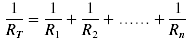
For example, two 8Ω loudspeakers have a combined impedance of 4Ω:

Most PA system loudspeakers have a nominal impedance of 4Ω or 8Ω. However, in applications where it may be advantageous to drive a larger number of speakers from a single amplifier channel (high frequency clusters are one such application), 16Ω or higher impedances may be found.
Generally, a single amplifier channel will comfortably drive one 4Ω speaker, two 8Ω speakers, or four 16Ω speakers, and although many modern amplifiers claim to be able to handle 2Ω loads it is good practice to avoid loading an amplifier channel with a combined impedance of less than 4Ω. Lower impedances reduce the amplifier's effective damping factor, and increase the relative power loss in loudspeaker cables. At best, powering lower than 4Ω nominal loads will result in some loss of audio quality. At worst, your amplifier will overheat and shut down or burn out during a show.
You can find a tool for calculating the total impedance of multiple loudspeakers (as well as the effect of cable on damping factor) on our System Calculations page.