Multi-Enclosure Loudspeaker Systems
Using Separate Cabinets for Different Frequency Ranges
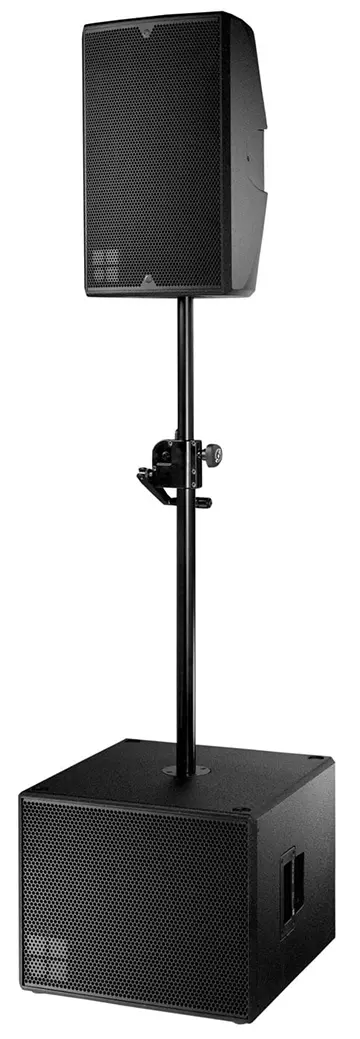
A Multi-Enclosure Loudspeaker System uses more than one type of cabinet.
What it is
It is a loudspeaker system in which different parts of the audio frequency range are reproduced by different cabinets. Older large concert systems often used separate boxes for each individual range, sometimes having cabinets for each of sub-bass, bass, low-mid, high-mid, high-frequency and very high-frequency. Modern systems have compacted this arrangement somewhat, and most now use only two or three different cabinets.
What it does
A multi-enclosure speaker system generally does what a single full-range box does: it is used to provide the front-of-house sound. The common principal difference is that there is an extra bass or sub-bass enclosure (although there may also be other separate enclosures covering different frequency bands). This offers several advantages over a single-box system:
- The system has greater ability to handle low frequency sounds (e.g. bass instruments, kick drums, and the lowest notes on a keyboard).
- Low frequency output is improved when a speaker is on or near the ground, while mid and high-frequencies achieve better dispersion from higher positions. With separate boxes, you can put the bass speakers on the floor and mount the mid and high-frequency speakers on elevated stands, or even use flying frames and hoists. You get the best of both worlds.
- Each box can be optimally designed for the drivers in it. You get improved efficiency and better pattern control.
- Two or more smaller boxes are easier to lift and move around than one bigger box.
- Such systems are usually ‘active’ (i.e. they use active crossovers and extra amplifiers to handle the respective frequency bands). This means more headroom and better driver protection.
In many smaller systems (see our 1.6kW Full Concert System for example), the mid and high-frequencies are dealt with by a small ‘full-range’ speaker, with an extra speaker employed to handle the lowest frequencies.
This relieves the low-frequency driver in the ‘full-range’ cabinet of the need to handle the lowest frequencies, so its efficiency and output are slightly improved.
How it works
Each individual driver works as described in the Full-range section.
In the most basic multi-enclosure systems, a passive high-pass filter (a sort of one-way crossover) is built in to the sub-bass cabinet, and this feeds a satellite mid/high-frequency speaker. A passive system like this only requires one amplifier, which saves money, weight and space. The disadvantage of this arrangement is that a single amplifier is handling the entire frequency range, which compromises headroom and risks damage to the HF driver if amplifier clipping occurs.
However, most multi-enclosure systems are at least partially (if not fully) active: an active crossover separates audio frequencies into at least two bands. In fully active systems there will generally be at least three (and commonly four) bands, where each band is covered by its own amplifier. In high-power systems the most common arrangement splits the audio frequency range into four, which (depending on crossover frequencies) will usually be described either as sub-bass, bass, mid and high-frequency, or as bass, low-mid, high-mid and high-frequency.
In high-power systems horn-loading is usual for at least the low-mid and all higher frequencies. Because of the wavelengths involved, pattern control is difficult to achieve at the lowest frequencies, and horn dimensions can be impractically large. For this reason, bass or sub-bass enclosures are often either front-loaded ported enclosures (simple, but effective), or bandpass (less even, but more compact).
Ported and bandpass enclosures use the same principle (the Helmholtz resonator) to maximise low frequency output. A Helmholtz resonator is basically a container of gas (e.g. air) with a hole in it. Blowing across the top of an empty bottle demonstrates the effect. The resonant frequency depends mainly on the size of the hole (and length of any tube leading to the hole), and the volume of the container. Partly filling a bottle with water and then blowing across the top of it demonstrates the effect of enclosure size on resonant frequency. Ported and bandpass enclosures match the driver characteristics to the resonance of the enclosure, and yield improved efficiency near resonance. In ported enclosures, this helps to maintain output at the lower end of the driver's range, where its efficiency would otherwise fall. In bandpass enclosures, the resonance of the box is a design feature, and output falls rapidly above and below resonance. In enclosures that only need to cover a narrow frequency band (two octaves or less) this is generally an advantage, although ‘boominess’ can be an unwanted side-effect.
Next to these methods, the most common approach to handling low frequencies in a container of manageable size is probably the folded horn (used, for example, in Martin Audio WSX loudspeakers). Here, the driver is mounted in one corner of the enclosure, and the horn follows a spiral inside the cabinet. This allows a horn (with a horn length of a couple of metres or more) to fit in a box of smaller dimensions than the horn length.
Front-loaded and bandpass bass enclosures have almost no control over the direction of radiation (they are to all intents and purposes omnidirectional). Folded horn enclosures, however, can be more directional, as well as more efficient. Other methods of low-frequency pattern control include d&b audiotechnik's cardioid B4 subwoofer, which achieves directional control by using acoustic loading and a rear-facing second driver to cancel output from the rear of the cabinet. Some control can also be achieved by arraying bass cabinets (see the section on bass loudspeaker pattern. However, achieving directional control in a single bass speaker can only be achieved by increasing size, weight, and cost.
How do you use it?
Principles of operation in a multi-enclosure PA system are similar to a full-range system. Extra points to bear in mind are:
- Keep the bass/sub-bass units on the ground, if possible.
- Placing the bass/sub-bass units together will increase the output, and it may be better to cluster these centrally or array them across the front of the stage than to position them at either side of the stage (see the section on Bass Speaker Position for more information).
- Phase relationships between the low- and higher-frequency cabinets at or near the crossover frequency can require complicated correction.
- Arraying HF units in multiples can involve other phase-related problems (see the section on Phase).
Do you need one?
If you need high sound pressure levels (or deep bass response, even if this is at a lower level) then you probably need more than a single-box system.
What sort do you need?
There are many multi-enclosure systems available. Your selection should be informed by similar criteria to those used to select a single full-range enclosure. Additional things to consider are:
- How many amplifiers you will need.
- Whether the system will fit in the vehicle you plan to use.
- How many years it will take to pay for it.